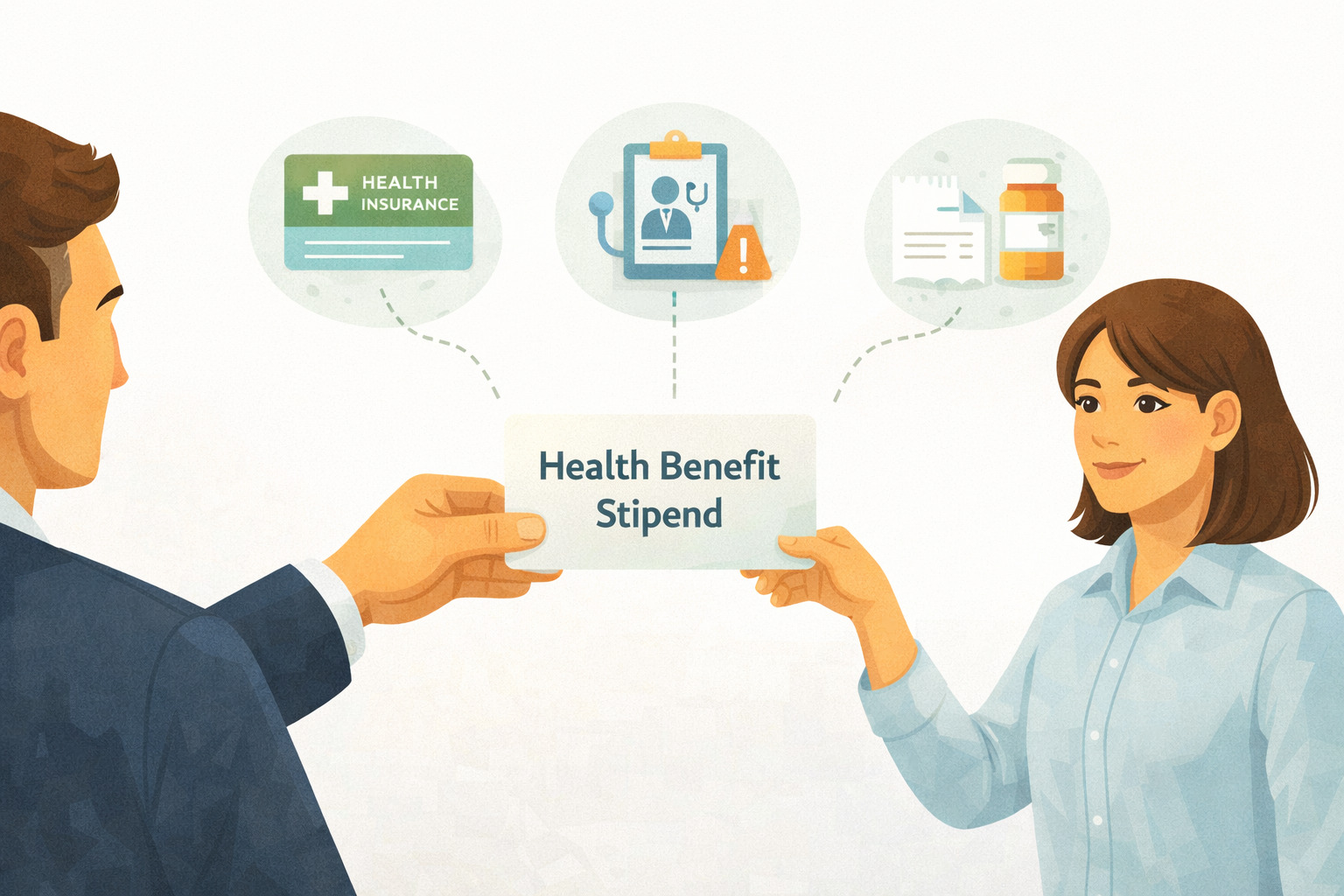

A health benefit stipend is a set amount of money an employer provides to employees to help cover health-related costs. In practice, companies use the term "stipend" in a few different ways:
- A stipend that is added to an employee's paycheck without any verification requirements.
- A stipend paired with a more structured program, such as help paying for individual health insurance that requires proof of coverage or documentation of related expenses.
Because "stipend" is not a single, standardized legal benefit design, the exact setup determines how it works for both the employer and the employee.
How Health Benefit Stipends Usually Work
Most health benefit stipends include a few core elements:
- Monthly allowance
- Example: $300 per full-time employee per month.
- Eligible expenses
- Some stipends have no restrictions on what they can be used for
- Some stipends are limited to health insurance premiums.
- Others allow a broader set of medical expenses.
- Payment method
- Some employers pay the stipend automatically.
- Others require proof of coverage or receipts.
- Rules by employee type
- Many employers vary the stipend based on full-time/part-time status or family size.
When and Why Employers Choose Health Benefit Stipends
Employers often consider a stipend when:
- They want to help with health coverage, but do not want to manage a group health plan.
- They have a distributed team and want a flexible approach across states.
- They are too small to get good group rates.
- They want a first step toward offering benefits.
- They don't want to disqualify employees from premium tax credits
Pros and Cons of Health Benefit Stipends
Pros
- Easy to budget: a fixed amount per employee.
- Flexible: employees can often choose the coverage that fits their situation.
- Simplicity: Can be simpler to start than a traditional group plan.
Cons
- Tax treatment may reduce value if the stipend is simply paid as wages.
- Compliance risk if the stipend is structured like reimbursement for individual health insurance without the right framework.
- Employee experience varies: employees may need help shopping for coverage and understanding what to buy.
Stipend vs. Traditional Group Health Insurance
A traditional group health insurance plan is a formal employer-sponsored health plan with defined enrollment, carrier relationships, and employer contributions. A stipend is typically a budgeted allowance. The employer is not sponsoring a health plan at all.
If the goal is to provide meaningful help with health coverage, employers often compare stipends with alternatives such as:
- Reimbursement-based benefit designs like health reimbursement arrangements (HRAs)
- Traditional group health insurance
- PEO group health insurance
A Health Benefits Broker Like LegUp Health Can Help
If you are trying to decide whether a health benefit stipend makes sense for your team, a health benefits broker like LegUp Health can help you:
- Compare a stipend to other benefit approaches.
- Estimate the employee impact and total cost.
- Set up a benefit that is clear for employees and aligned with your goals.
Frequently Asked Questions
Is a health benefit stipend taxable?
Often, yes. If it is paid as additional wages, it is typically treated like normal income. Some more structured approaches may be treated differently depending on the design.
Can employees use a stipend to buy their own health insurance?
Yes, but it depends on how the stipend is set up and what the employer allows.
What is the difference between a health stipend and a health reimbursement arrangement?
A stipend is usually a fixed allowance tied to having an expense related to a benefit category. Reimbursement typically requires submitting proof of an eligible expense and receiving reimbursement.
Can a stipend replace health insurance?
A stipend can help employees pay for coverage, but it is not the same as sponsoring a health plan. Many employers use stipends as a step toward more robust benefits.
Ready to Offer a Health Benefit Stipend Without the Spreadsheets? LegUp Health specializes in health benefit stipend programs for small employers. We can help you design a stipend that employees understand and implement a simple system to manage it without paper forms or manual spreadsheets. Book a consultation today!